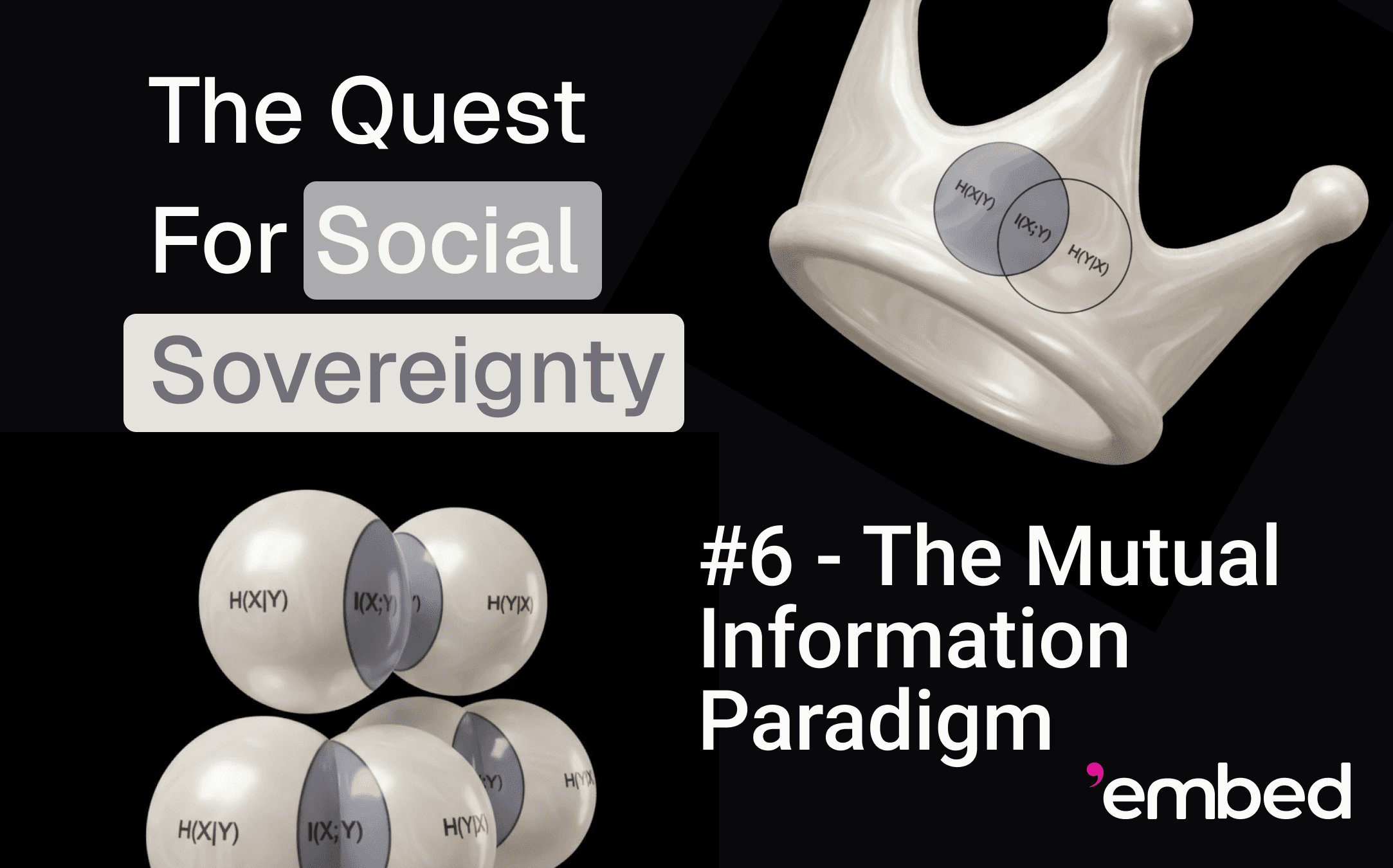
What is the Mutual Information Paradigm (MIP)?
We would like to dedicate this blog post to the Mutual Information Paradigm (MIP) of mechanism construction by Kong and Schoenebeck [3], as well as to its flagship mechanism Determinant Mutual Information (DMI) [1] and mechanism class Volume Mutual Information (VMI) [2]. These mechanisms stood out in the survey of social epistemic mechanisms for content moderation that we conducted in our previous blog post. We believe they already can be used in practical applications, such as a better version of Community Notes.
Recall that our goal is to obtain a mechanism with the following desiderata: truthfulness, collusion resistance, minimalism, agent heterogeneity, simplicity, small population, effort incentivization and flexible risk profiles. With the lottery trick we mentioned, VMI mechanisms such as DMI satisfy all of our desiderata, with the notable exception of collusion resistance and, depending on the point of view, of simplicity, though it is certainly not one of the hardest mechanisms to understand. While the lack of collusion resistance does hinder its employment in a decentralized setting, the ideas behind these mechanisms are so powerful and beautiful that they merit being known. It is also worth understanding how these mechanisms fail in the presence of coalitions, so as to guide future mechanism design.
Blog Sections
This blog is organised in 2 sections:
Mechanism Explanation and Assumptions where we will go through the mechanism under the two assumptions below and share an observation and a proposition.
Assumption (A Priori Similar Tasks). All tasks have the same statistical type.
Assumption (Consistent Strategies). Each agent employs the same strategy for all tasks.
Collusion Resistance where we will explain the three main reasons why these mechanisms do not resist coordinated coalitions with 3 simple examples
Will end with some conclusions.
Read it below
Because this blog post is maths heavy, we invite you to read this on our research blog: https://research.getembed.ai/www/blog/6.html
Series Recap
In the first six blog posts in this series, we introduced the key concepts and problems underlying decentralized moderation and epistemology, as well as surveyed different strategies to tackle them, including using prediction markets and mechanisms from the literature of Information Elicitation Without Verification (IEWV). The conclusion so far is that none of these methods is a perfect fit, but that they are powerful tools with plenty of application potential.
In the future, we will consider other approaches to tackling the decentralized moderation problem. As a matter of fact, we are working on an entirely different direction right now. However, for the short term, we will be taking a break in this series. If the content exposed here so far is of interest to you, feel free to reach out at [email protected].
References
[1] Yuqing Kong. Dominantly truthful multi-task peer prediction with a constant number of tasks. 2019.
[2] Yuqing Kong. Dominantly truthful peer prediction mechanisms with a finite number of tasks. J. ACM, 71(2):9–1, 2024.
[3] Yuqing Kong and Grant Schoenebeck. An information theoretic framework for designing information elicitation mechanisms that reward truth-telling. 2018.
[4] Wikipedia. Stochastic matrix — Wikipedia, the free encyclopedia. https://en.wikipedia.org/wiki/Stochastic_matrix, 2024. [Online; accessed 29-October-2024].